Amina's First Day
Emotion-aware storytelling for cultural learning
Amina's First Day is an interactive digital storybook that uses affective computing to help young students recognize emotions, build empathy, and engage with social-emotional learning through culturally grounded storytelling.
Timeline
8 weeks
Roles
- Experience Designer
- Illustrator
Skills
- Game mechanics
- Narrative design
- Visual design
Tools
- Figma
- Procreate
- After Effects
Project Overview
Amina's First Day was the final project for Affective Interfaces. We designed a digital interactive storybook to build emotional literacy through emotion detection software.
How might we leverage digital storytelling and emotionally responsive technologies to foster social-emotional learning and cultural awareness in elementary students?
Storyline & User Flow
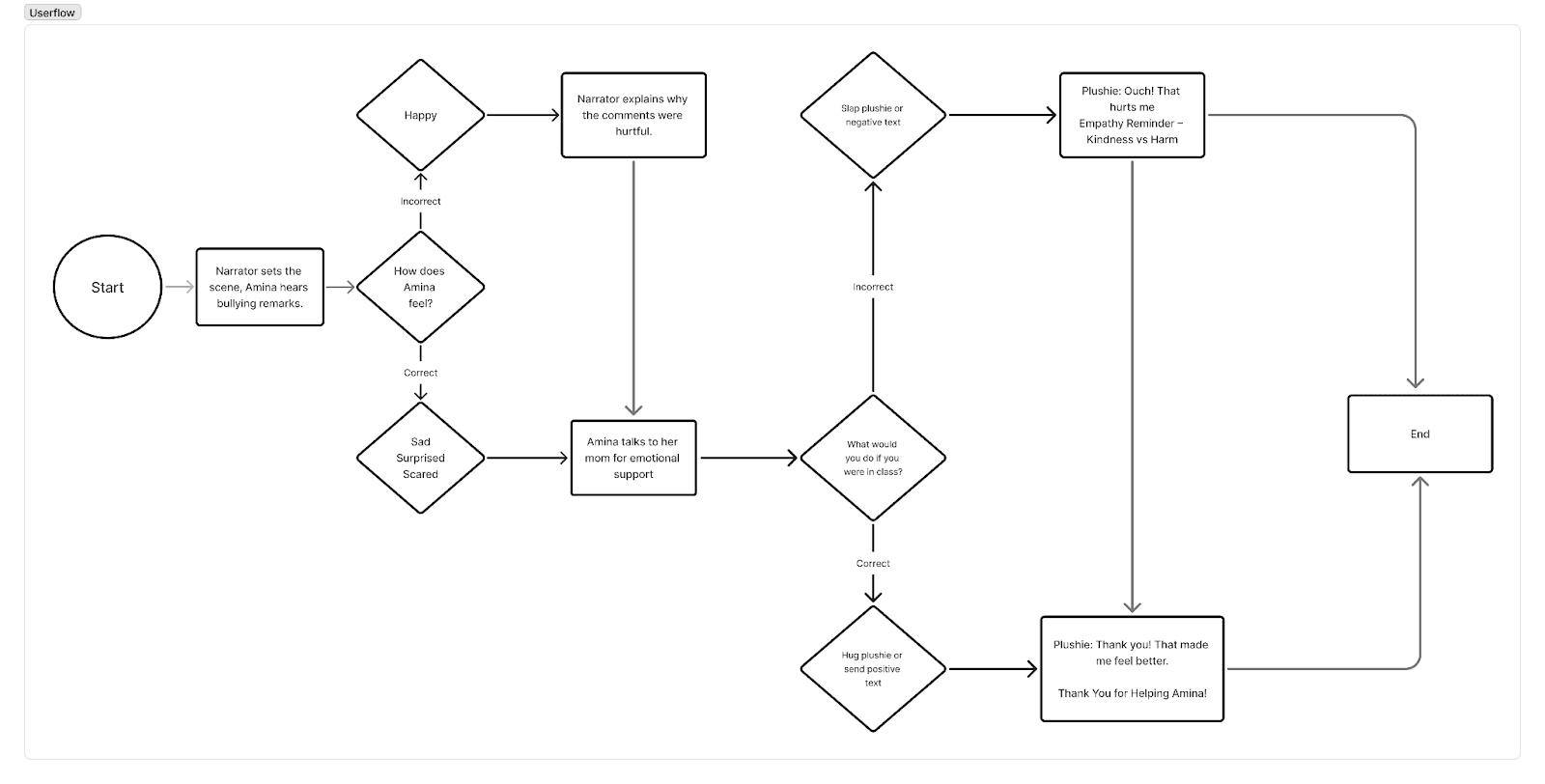
The experience follows Amina, a young Muslim girl navigating her first day of 5th grade, where she faces microaggressions from peers. As readers move through the story, they identify Amina's emotions through multiple-choice prompts and real-time facial expression detection.
Based on their responses, the story either continues or pauses for a teachable moment, reinforcing empathy and anti-bias learning.
Preliminary Research & Pain Points
We conducted qualitative interviews with 2 elementary school teachers and 3 student teachers and identified 3 main pain points in SEL and cultural learning:
- Inconsistent or superficial SEL integration
- Limited cultural learning opportunities
- Teacher overload and curriculum constraints
In response, we designed a prototype of an interactive storybook. The experience was built using p5.js and adapted facial detection software. While the narrative maintained a familiar “next” button for structural clarity, facial expression recognition was embedded as an affective interaction layer. Rather than replacing navigation, the system leveraged children’s emotional responses as a form of participatory input — shaping select narrative moments and reinforcing engagement through embodied feedback.
Designed specifically for children ages 6–8, the interface minimized reliance on reading and writing, prioritizing visual communication, intuitive affordances, and developmentally appropriate interaction patterns.
Technical Implementation
- Built with p5.js and adapted facial detection software
- Story progression controlled by emotional input
- Two interactive emotional decision points in the narrative
While limited in scope, the prototype demonstrated how affective computing can support emotional reflection in storytelling.
Demo
Takeaways & Reflections
Educators found the experience engaging and well-suited for younger learners, describing it as a more interactive alternative to standard SEL activities.
Feedback also raised critical questions about privacy, consent, and ethical use of facial data. This reinforced the need for transparent communication and opt-in design as the product evolves.